Heritage · Museum
Louvre Museum: Iconic Art, History & Exhibits
Louvre Museum showcases a rich collection of artifacts, art, and cultural history. Explore exhibits, key highlights, and visitor information.Written to last.
By Confinity Heritage Editorial · Updated 2026-07-20 · 7-minute readQuiet tools, kept out of the way.
Few buildings hold as much of the world's gathered memory as the Louvre. It stretches along the right bank of the Seine in the centre of Paris, a former royal palace that now shelters roughly 500,000 objects, of which about 35,000 are on view at any one time (Wikipedia). In a single afternoon a visitor can stand before a Babylonian law code carved almost four thousand years ago, a Greek goddess sculpted before the Roman Empire existed, and a small poplar panel painted by Leonardo da Vinci. No art museum on earth draws more people: 8.7 million came through its doors in 2024 (Musée du Louvre).
Its scale is hard to hold in the mind. The galleries fill more than 72,000 square metres of exhibition space, and the collection follows human making from the ancient Near East and Egypt through the classical Mediterranean to European painting and sculpture up to the middle of the nineteenth century. The building is not only a container for those treasures. Its walls record eight centuries of French history, from a medieval fortress raised against invasion, to a palace of kings, to a public institution born of revolution.
At the museum's core lies a plain idea that took centuries to arrive: that the finest work a society produces belongs to everyone. When the Louvre opened in 1793 it turned a private royal collection into shared property. That act, as much as any single painting on its walls, is what the place preserves.
The Louvre began not as a home for art but as a line of defence. Around 1190, King Philip II Augustus ordered a fortress built on the western edge of Paris before he left on crusade, guarding the city against attack from the river (Wikipedia). For more than two centuries it stayed a working stronghold, its circular keep ringed by a moat. The foundations of that first castle still survive beneath the modern museum, and visitors can walk down to see them.
The transformation from fortress to palace came with the Renaissance. In 1546 King Francis I, who had already brought Leonardo da Vinci to France and acquired the Mona Lisa, commissioned the architect Pierre Lescot to replace the medieval castle with a residence in the new Italian manner of symmetry and proportion (Wikipedia). Over the following two centuries a succession of kings and architects extended the palace: Louis Le Vau and Claude Perrault under Louis XIV, and later builders who slowly closed the vast courtyards into the shape recognisable today. When Louis XIV moved his court to Versailles in 1682, the half-finished Louvre was left partly to artists and academies, who took up lodgings and studios inside it.
The decisive change was political. During the French Revolution the National Assembly decreed that the royal collection should become a public museum, and on 10 August 1793 the Louvre opened as the Muséum central des Arts de la République, showing an initial group of works drawn from the crown and from property seized from the church and emigrant nobility (Wikipedia). For the first time the paintings that had hung in palaces were open to any citizen who cared to look. Under Napoleon the museum was briefly renamed the Musée Napoléon and swelled with art carried back from his campaigns across Europe, much of which was returned to its countries of origin after his fall in 1815. Through the nineteenth century the collection kept growing by purchase, excavation and bequest, and the palace itself reached close to its final extent under Napoleon III.
The Louvre organises its holdings into eight curatorial departments, a structure that maps the reach of the collection: Egyptian Antiquities; Near Eastern Antiquities; Greek, Etruscan and Roman Antiquities; Islamic Art; Sculpture; Decorative Arts; Paintings; and Prints and Drawings (Wikipedia). Together they cover a span from the earliest civilisations of Mesopotamia to European art of the mid-1800s, the point at which the neighbouring Musée d'Orsay picks up the story of Impressionism and after.
The single most sought work is the Mona Lisa, Leonardo da Vinci's portrait of Lisa Gherardini, painted in oil on a poplar panel and generally dated to between about 1503 and 1519 (Wikipedia). The panel is modest in size, 77 by 53 centimetres, and hangs behind protective glass in the Salle des États, where it is watched by a near-constant crowd. Its fame is partly a matter of quality and partly an accident of history, a story taken up further below.
Sculpture from the ancient Mediterranean gives the museum two of its other emblems. The Venus de Milo, a Parian marble figure standing over two metres tall and thought to represent Aphrodite, was carved somewhere around 150 to 110 BC and found by a farmer on the Greek island of Milos on 8 April 1820, entering the Louvre the following year (Wikipedia). The Winged Victory of Samothrace, a marble Nike alighting on the prow of a ship, dates to roughly 190 BC and was discovered on the island of Samothrace in 1863; since the 1880s it has stood at the head of the Daru staircase, where its wind-filled drapery meets visitors as they climb (Wikipedia).
The Near Eastern galleries hold objects that reshaped how scholars understand early law and writing, chief among them the stele of the Code of Hammurabi, a black basalt pillar inscribed with one of the oldest surviving legal texts, dating to the Babylon of the eighteenth century BC. The Egyptian department, one of the largest outside Cairo, ranges from monumental statuary such as the Great Sphinx of Tanis to everyday objects, jewellery and papyri that record ordinary life along the Nile.
The painting collection is equally deep. Alongside the Mona Lisa hang landmarks of French art: Eugène Delacroix's Liberty Leading the People, painted after the revolution of 1830; Théodore Géricault's Raft of the Medusa, based on a contemporary shipwreck and scandal; and Jacques-Louis David's enormous Coronation of Napoleon. The largest canvas in the museum is Paolo Veronese's Wedding at Cana, a sixteenth-century Venetian banquet scene so wide that it faces the Mona Lisa across the same room. Beyond the works on the walls, the department of Prints and Drawings guards a graphic collection numbering in the hundreds of thousands of sheets, most of them too fragile for permanent display and shown only in rotation.
The collection also reaches well past Europe and the classical Mediterranean. The Department of Islamic Art opened dedicated galleries in a courtyard of the Denon wing on 22 September 2012, set beneath a wave-like glass and metal canopy designed by Mario Bellini and Rudy Ricciotti, and gathers ceramics, metalwork, carpets and manuscripts spanning Spain to India across more than a thousand years (Wikipedia). The Decorative Arts department holds furniture, tapestries, enamels and the French crown jewels, the last displayed in the gilded Galerie d'Apollon, a seventeenth-century room whose painted ceiling helped shape the young Louis XIV's image as the Sun King.
The Louvre is, in effect, several buildings grown together over eight hundred years, and reading its architecture is a way of reading French history. The oldest layer lies underground. When the courtyard was excavated during modernisation work in the 1980s, the moat and the base of Philip Augustus's twelfth-century keep were uncovered, and they are now open to visitors in the Medieval Louvre rooms, a rare chance to touch the fortress beneath the palace (Wikipedia).
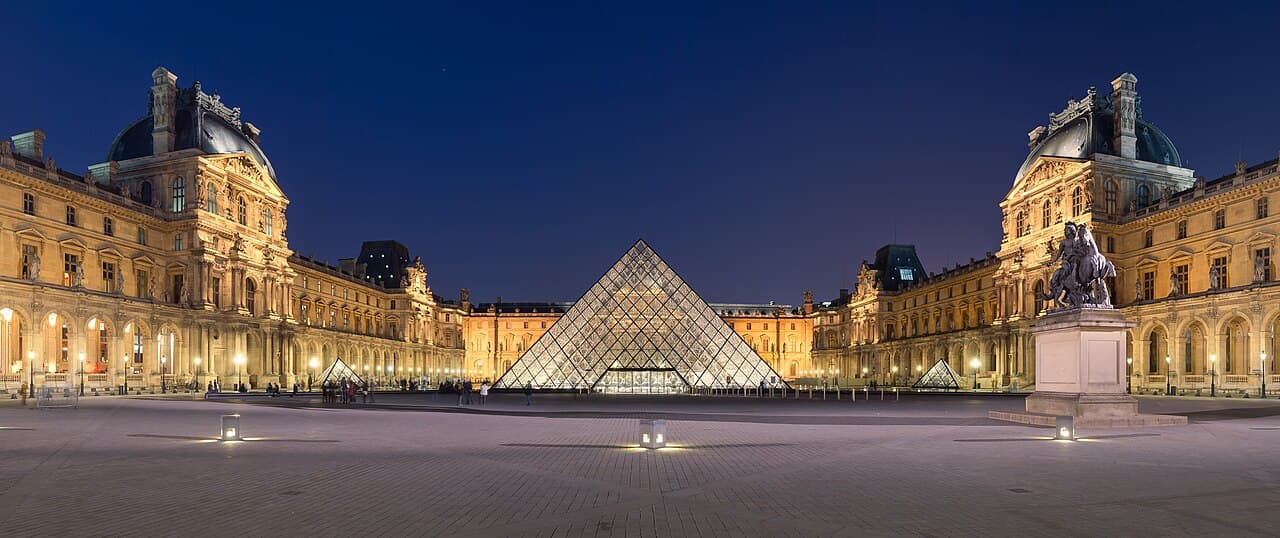
 Pei's pyramid was widely detested when it was announced in 1984 and is now the image most people carry of the museum. Photograph by Babyaimeesmom, CC BY-SA 4.0, via Wikimedia Commons.
Above ground, the palace carries the styles of the centuries that built it. Pierre Lescot's Renaissance wing from the mid-1500s introduced classical order to what had been a defensive castle. The seventeenth century added the grander, more sculptural facades of Le Vau and the severe eastern colonnade of Claude Perrault. Later kings and emperors closed and decorated the wings until the palace formed the long arms that embrace the Cour Napoléon today. For most of its life the building faced inward toward the crown, and its plan still shows that history of accumulation rather than a single design.
The most recognisable modern addition is the glass pyramid in the central courtyard, the work of the architect I. M. Pei. It was part of the Grand Louvre project announced in 1981 by President François Mitterrand, a scheme to reorganise a museum that had grown crowded and hard to navigate (Wikipedia). Completed in 1989, the pyramid rises 21.6 metres and is built from 673 glass panes set in a steel frame, funnelling visitors down into a spacious underground lobby that connects the three wings. Its clear geometry against the ornate stone palace provoked fierce argument when it was unveiled, with critics calling it out of place beside a Renaissance building. In the decades since it has become one of the settled images of Paris. The same project reclaimed the north Richelieu wing, long occupied by a government ministry, and opened it to the public as gallery space in 1993.
The Louvre occupies a place in French national life that goes beyond its collection. It stands at the eastern end of the historic axis that runs through the Tuileries garden and up the Champs-Élysées, and it forms part of the "Paris, Banks of the Seine" site inscribed on the UNESCO World Heritage List in 1991 (UNESCO). Its transformation from royal palace to public museum in 1793 became a model that other nations followed, helping to establish the idea that a great collection is a civic trust rather than private property.
Two episodes did as much as any masterpiece to fix the museum in the popular imagination. On 21 August 1911 the Mona Lisa was stolen from the wall by Vincenzo Peruggia, an Italian workman who had helped fit the painting's protective case and simply walked out with it under his coat. The theft filled newspapers around the world for two years, and when the picture was recovered in Florence in December 1913 and returned to Paris, it came back more famous than it had ever been (Wikipedia). Much of the dense modern crowding around the portrait dates from that scandal rather than from any sudden change in taste.
The second episode came with the Second World War. Anticipating invasion, the director of France's national museums, Jacques Jaujard, organised the quiet evacuation of the collection before the fighting reached Paris. Beginning in late August 1939, staff, students and volunteers packed thousands of works into wooden crates and moved them out of the city in convoys of trucks to châteaux in the countryside (Wikipedia). The Mona Lisa travelled under a coded label to hide its identity, and the collection was shifted from refuge to refuge through the occupation, returning largely intact after 1945. That rescue is remembered as one of the more careful acts of cultural protection in modern history.
The fragility of such a collection was made plain again in October 2025, when thieves forced a window of the Galerie d'Apollon and removed several pieces of the French crown jewels in a matter of minutes (Wikipedia). The theft revived old questions about how even the most visited museum on earth can guard what has been entrusted to it, and it was a reminder that preservation is never finished work.
Strip away the crowds and the fame, and the Louvre does something quite ordinary at heart: it keeps things that would otherwise be lost, and it keeps the reasons they mattered to the people who made them. A clay tablet survives because someone chose to save it, and then someone chose to save it again, across forty centuries of chance and war. The museum is the sum of those repeated choices to hold on.
What it preserves is not only objects but continuity. The law carved on the Hammurabi stele can still be read; the face Leonardo painted still meets a viewer's eye; the fortress that a medieval king built to defend a frightened city still stands, layer beneath layer, under the marble floors. Each of these outlived the person who made it because an institution decided it was worth the trouble of keeping. The Louvre is a working argument that the past is not automatically retained. It has to be chosen, catalogued, guarded and passed on, or it disappears.
That is a quiet lesson for anyone who cares about the things worth keeping, whether a nation's art or a single family's record of itself. The scale differs, but the principle is the same. Memory does not survive on its own. It survives because someone takes responsibility for it, gives it a place, and hands it forward to the people who come next. The Louvre has been doing exactly that, imperfectly and at enormous scale, for more than two hundred years.
The Louvre stands in the 1st arrondissement of Paris, with its main entrance through the glass pyramid in the Cour Napoléon; the address is Rue de Rivoli, 75001 Paris. The nearest Métro station is Palais Royal–Musée du Louvre, which connects directly to the underground Carrousel du Louvre and offers a less crowded way in than the pyramid itself. The Louvre-Rivoli station is a short walk away, and several bus lines serve the surrounding streets. Because the museum sits in the dense centre of the city, public transport is far more practical than driving.
The galleries are open most days from 9 a.m., and the museum closes on Tuesdays and on 1 January, 1 May and 25 December. On certain evenings it stays open late, which is often the calmest time to see the best-known rooms. Because the building is vast, most visitors do better to choose a few departments in advance than to attempt everything in one day; free maps are available at the information desk beneath the pyramid, and timed tickets booked online reduce the wait at the entrance. Admission is free for visitors under 18 and for residents of the European Economic Area under 26, and the museum offers a number of free-entry days through the year. Current hours, prices and booking details are published on the museum's official website, which is the most reliable source given that they change from season to season (Musée du Louvre).
A practical word on the crowds. The Louvre is the most-visited art museum in the world, and the Salle des États, where the Mona Lisa hangs, is the single most congested room in it. Arriving at opening, or on a late evening, and walking against the flow of the guided tours makes a real difference. The quieter departments, among them Near Eastern Antiquities, Islamic Art and the French sculpture courts, reward the visitor who is willing to step away from the three or four most photographed works and give the rest of the collection its due.
Pei's pyramid was widely detested when it was announced in 1984 and is now the image most people carry of the museum. Photograph by Babyaimeesmom, CC BY-SA 4.0, via Wikimedia Commons.
Above ground, the palace carries the styles of the centuries that built it. Pierre Lescot's Renaissance wing from the mid-1500s introduced classical order to what had been a defensive castle. The seventeenth century added the grander, more sculptural facades of Le Vau and the severe eastern colonnade of Claude Perrault. Later kings and emperors closed and decorated the wings until the palace formed the long arms that embrace the Cour Napoléon today. For most of its life the building faced inward toward the crown, and its plan still shows that history of accumulation rather than a single design.
The most recognisable modern addition is the glass pyramid in the central courtyard, the work of the architect I. M. Pei. It was part of the Grand Louvre project announced in 1981 by President François Mitterrand, a scheme to reorganise a museum that had grown crowded and hard to navigate (Wikipedia). Completed in 1989, the pyramid rises 21.6 metres and is built from 673 glass panes set in a steel frame, funnelling visitors down into a spacious underground lobby that connects the three wings. Its clear geometry against the ornate stone palace provoked fierce argument when it was unveiled, with critics calling it out of place beside a Renaissance building. In the decades since it has become one of the settled images of Paris. The same project reclaimed the north Richelieu wing, long occupied by a government ministry, and opened it to the public as gallery space in 1993.
The Louvre occupies a place in French national life that goes beyond its collection. It stands at the eastern end of the historic axis that runs through the Tuileries garden and up the Champs-Élysées, and it forms part of the "Paris, Banks of the Seine" site inscribed on the UNESCO World Heritage List in 1991 (UNESCO). Its transformation from royal palace to public museum in 1793 became a model that other nations followed, helping to establish the idea that a great collection is a civic trust rather than private property.
Two episodes did as much as any masterpiece to fix the museum in the popular imagination. On 21 August 1911 the Mona Lisa was stolen from the wall by Vincenzo Peruggia, an Italian workman who had helped fit the painting's protective case and simply walked out with it under his coat. The theft filled newspapers around the world for two years, and when the picture was recovered in Florence in December 1913 and returned to Paris, it came back more famous than it had ever been (Wikipedia). Much of the dense modern crowding around the portrait dates from that scandal rather than from any sudden change in taste.
The second episode came with the Second World War. Anticipating invasion, the director of France's national museums, Jacques Jaujard, organised the quiet evacuation of the collection before the fighting reached Paris. Beginning in late August 1939, staff, students and volunteers packed thousands of works into wooden crates and moved them out of the city in convoys of trucks to châteaux in the countryside (Wikipedia). The Mona Lisa travelled under a coded label to hide its identity, and the collection was shifted from refuge to refuge through the occupation, returning largely intact after 1945. That rescue is remembered as one of the more careful acts of cultural protection in modern history.
The fragility of such a collection was made plain again in October 2025, when thieves forced a window of the Galerie d'Apollon and removed several pieces of the French crown jewels in a matter of minutes (Wikipedia). The theft revived old questions about how even the most visited museum on earth can guard what has been entrusted to it, and it was a reminder that preservation is never finished work.
Strip away the crowds and the fame, and the Louvre does something quite ordinary at heart: it keeps things that would otherwise be lost, and it keeps the reasons they mattered to the people who made them. A clay tablet survives because someone chose to save it, and then someone chose to save it again, across forty centuries of chance and war. The museum is the sum of those repeated choices to hold on.
What it preserves is not only objects but continuity. The law carved on the Hammurabi stele can still be read; the face Leonardo painted still meets a viewer's eye; the fortress that a medieval king built to defend a frightened city still stands, layer beneath layer, under the marble floors. Each of these outlived the person who made it because an institution decided it was worth the trouble of keeping. The Louvre is a working argument that the past is not automatically retained. It has to be chosen, catalogued, guarded and passed on, or it disappears.
That is a quiet lesson for anyone who cares about the things worth keeping, whether a nation's art or a single family's record of itself. The scale differs, but the principle is the same. Memory does not survive on its own. It survives because someone takes responsibility for it, gives it a place, and hands it forward to the people who come next. The Louvre has been doing exactly that, imperfectly and at enormous scale, for more than two hundred years.
The Louvre stands in the 1st arrondissement of Paris, with its main entrance through the glass pyramid in the Cour Napoléon; the address is Rue de Rivoli, 75001 Paris. The nearest Métro station is Palais Royal–Musée du Louvre, which connects directly to the underground Carrousel du Louvre and offers a less crowded way in than the pyramid itself. The Louvre-Rivoli station is a short walk away, and several bus lines serve the surrounding streets. Because the museum sits in the dense centre of the city, public transport is far more practical than driving.
The galleries are open most days from 9 a.m., and the museum closes on Tuesdays and on 1 January, 1 May and 25 December. On certain evenings it stays open late, which is often the calmest time to see the best-known rooms. Because the building is vast, most visitors do better to choose a few departments in advance than to attempt everything in one day; free maps are available at the information desk beneath the pyramid, and timed tickets booked online reduce the wait at the entrance. Admission is free for visitors under 18 and for residents of the European Economic Area under 26, and the museum offers a number of free-entry days through the year. Current hours, prices and booking details are published on the museum's official website, which is the most reliable source given that they change from season to season (Musée du Louvre).
A practical word on the crowds. The Louvre is the most-visited art museum in the world, and the Salle des États, where the Mona Lisa hangs, is the single most congested room in it. Arriving at opening, or on a late evening, and walking against the flow of the guided tours makes a real difference. The quieter departments, among them Near Eastern Antiquities, Islamic Art and the French sculpture courts, reward the visitor who is willing to step away from the three or four most photographed works and give the rest of the collection its due.
History and founding
The collection
The building
Cultural significance
What it preserves
Visiting
References and resources
- Musée du Louvre, official site: hours, tickets, collection database and current exhibitions.
- Musée du Louvre press office: 8.7 million visitors in 2024: official attendance figures and visitor breakdown.
- Wikipedia: Louvre: history, architecture, collection size and departments.
- Wikipedia: Louvre Pyramid: I. M. Pei, dimensions and construction of the pyramid.
- Wikipedia: Mona Lisa: dating, dimensions and the 1911 theft.
- Wikipedia: Venus de Milo: discovery, date and material.
- Wikipedia: Winged Victory of Samothrace: date, discovery and display.
- Wikipedia: Evacuation of the Louvre collection during World War II: the wartime rescue led by Jacques Jaujard.
- UNESCO World Heritage: Paris, Banks of the Seine: the World Heritage inscription that includes the Louvre.